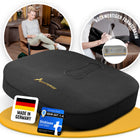
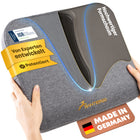


An orthopedic seat cushion made of molded foam offers you stability, ergonomic support and relieves the tailbone, back and hemorrhoids. Memory foam gets flattened – find out here why molded foam is the better choice.
Why memory foam is unsuitable for seat cushions
Memory foam does adapt to your body shape and feels comfortable at first, but under your weight it immediately loses its supporting shape. Many buyers report in reviews that memory foam cushions are flattened after a very short time and no longer provide ergonomic support.
No stability:
The memory foam material has no firmness, compresses too much and therefore offers no support.

Lack of ergonomics:
Memory foam is particularly unsuitable for hemorrhoids, for back problems or sensitive areas of the buttocks, because the material is too soft, twists or crumples too quickly and thus cannot guarantee shape stability.
Memory foam is useful in other situations:
For ski boots or insoles, memory foam is ideal because it yields precisely at pressure points and prevents pressure sores.
When sitting, however, the lack of shape stability causes the cushion to quickly lose its orthopedic effect.
Molded foam: supporting posture and long-term stability
The better choice for orthopedic sitting is high-quality molded foam. Unlike memory foam:
-
Maintains its shape:
Molded foam provides a supporting posture and remains stable even under your body weight.

-
Pleasant sitting feel:
Through its special manufacturing, molded foam offers not only stability but also a certain pleasant softness.

-
Orthopedic support:
Pressure points in the buttocks are relieved and the Your spine optimally supported.

-
Long-term stability:
The cushion won’t get flattened and keeps the desired ergonomic shape for many years.

In Europe, only a few manufacturers master the optimal molded-foam production for comfortable, pleasant sitting. These specialized companies are either in Germany or Scandinavia and China definitely can’t compete here.
The right shape for orthopedic sitting
Besides the material, the shape of the cushion plays a central role. An anatomical design with gentle curves supports your natural sitting posture and relieves pressure points.
A common mistake with many so‑called orthopedic seat cushions is the U-shaped, i.e. open, continuous cut-out in the rear area.
Why that is problematic:
- The material can twist under load, causing the ergonomic shape to be lost.
- Especially with hemorrhoids the open cut-out can produce a pulling, painful effect.
- Cushions feel unstable, the spine is no longer in proper vertical alignment.
The optimal cut-out: 8-shaped and stable

The ideal solution is a 8-shaped recess in the rear seating area:
- Stable side walls:
At least 2 cm of material provide support.
- Base stability:
The cut-out should only be approx. 2/3 deep, so that there is still 1/3 The material as a base guarantees a supportive shape.
- No continuous recess:
Prevents twisting of the material and the painful pulling effect with hemorrhoids.
This construction ensures that your cushion relieves pressure, retains its ergonomic shape and responds stably to your sitting weight – something memory foam cannot do.
Conclusion: healthy sitting with molded foam
If you want to sit correctly from an orthopedic point of view, you should avoid memory foam and opt for high-quality molded foam – ideally from manufacturers who perfectly master material quality and anatomical shape. Pay attention to the 8-shaped cutout with stable side walls and base to optimally relieve your tailbone, hemorrhoids and your back.
With the right seat cushion, sitting finally becomes comfortable, stable and feels pleasant for longer periods – memory foam can safely stay in ski boots.
If the topic of ergonomics in the office or home office appeals to you and you want to explore it more deeply, I can recommend my book «Wellness in the Office». Combined with humorous drawings I give 50+1 tips on how to turn your office into a little paradise.